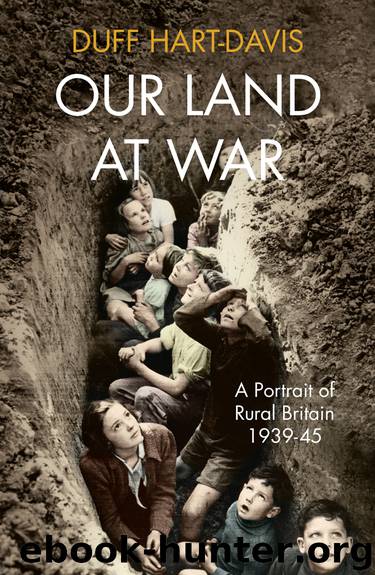
Our Land at War by Duff Hart-Davis
Author:Duff Hart-Davis
Language: eng
Format: epub
Publisher: HarperCollins Publishers
Published: 2015-03-17T04:00:00+00:00
It was a terrible place, cold, bleak, isolated. We faced a two-mile walk to our huts, which were as bad as you would find anywhere in the RAF. They were draughty, ran with condensation, and we had so little fuel for the single stove that some of the Aussies on the squadron took to stealing other people’s doors to burn. By the time I left there was hardly a lavatory door left.
Senior ranks were generally far more comfortable. At Woodhall Spa, also in Lincolnshire, which opened as a bomber base in 1940, the officers’ mess was the Petwood Hotel, formerly Petwood Park, once the home of Grace Maple, of the furniture family. Built in the early years of the twentieth century, in heavy Tudor-Jacobean style, the house had been a fashionable Edwardian health resort, served by through trains from London; in the First World War it had become a convalescent home, and now it was taken over again by the military.
The need for modern bases was driven partly by the increase in size and weight of the RAF’s bombers. The Hampdens, Whitneys and Wellingtons which began the offensive against Germany were too slow, too limited in bomb-carrying capacity and too poorly armed to be war winners. At least they had the merit of being able to land on grass. But it was in 1942, with the emergence of the four-engined Avro Lancaster, developed out of the underpowered Manchester, that concrete runways became essential.
‘Indisputably the great heavy night-bomber of the Second World War,’ wrote the historian Max Hastings, ‘the Lancaster inspired affection unmatched by any other British heavy bomber … Cruising at 216 mph, intensely durable and resistant to punishment … beautiful to the eye and carrying the bomb-load of two Flying Fortresses at 20,000 feet, [it] ranks with the Mosquito and the Mustang among the great design successes of the war.’ A Lanc, powered by four Rolls-Royce Merlin engines, could carry 14,000 lb of bombs and had a range of 1660 miles. In its final form it could accommodate the monstrous Grand Slam bomb, at 22,000 lb the largest carried by any aircraft in the war.
Lancasters were still supplanting earlier types when Bomber Command launched its first mass attack, on 30 May 1942. Frank Mee, the boy with a passion for dancing who lived at Norton-on-Tees in Co. Durham, could identify all the planes that took part. He was already something of an aircraft expert, since he frequently rode shotgun when his father, a haulage contractor, delivered material for the construction of runways.
Now, on a lovely summer evening, Frank and some friends were sailing their boats on the duck pond at Norton Green as people strolled round the garden, or sat about chatting – an idyllic scene.
Download
This site does not store any files on its server. We only index and link to content provided by other sites. Please contact the content providers to delete copyright contents if any and email us, we'll remove relevant links or contents immediately.
| Africa | Americas |
| Arctic & Antarctica | Asia |
| Australia & Oceania | Europe |
| Middle East | Russia |
| United States | World |
| Ancient Civilizations | Military |
| Historical Study & Educational Resources |
The Radium Girls by Kate Moore(12089)
100 Deadly Skills by Clint Emerson(4968)
Rise and Kill First by Ronen Bergman(4833)
The Templars by Dan Jones(4731)
The Doomsday Machine by Daniel Ellsberg(4538)
The Rape of Nanking by Iris Chang(4255)
Killing England by Bill O'Reilly(4041)
Stalin by Stephen Kotkin(4002)
Hitler in Los Angeles by Steven J. Ross(3974)
12 Strong by Doug Stanton(3575)
Hitler's Monsters by Eric Kurlander(3384)
The Code Book by Simon Singh(3249)
Blood and Sand by Alex Von Tunzelmann(3238)
Darkest Hour by Anthony McCarten(3161)
The Art of War Visualized by Jessica Hagy(3041)
Hitler's Flying Saucers: A Guide to German Flying Discs of the Second World War by Stevens Henry(2777)
Babylon's Ark by Lawrence Anthony(2716)
Tobruk by Peter Fitzsimons(2558)
The Second World Wars by Victor Davis Hanson(2553)
